Professional teams account for less than 0.1% of all football played worldwide. I led the 0-to-1 design for Forza Football Reporter, a web app and strategic initiative created to cover the 99.9% of matches that mainstream media ignores.
Partnering with a lean engineering squad, I designed a mobile tool that empowers fans, parents and coaches to live-report local games in a crowdsourcing manner. This platform finally enabled Forza Football's 3 million monthly active users to follow youth leagues and amateur matches with the exact same premium experience as top European leagues.
Team
Design & User research: Robin Höberg, Oscar Fredriksson.
Product & Engineering: Alex Sundbäck, David Söderberg, Jonathan Lundqvist, Kristoffer Melin, Thierry Godwin.
At the time, Forza Football was highly successful at delivering live scores for top-tier professional leagues, maintaining a stable base of over 3 million monthly active users. However, that overall user growth had plateaued. We needed a new engine to drive acquisition.
We hypothesized that the key to unlocking new growth lay in the 99.9% of football matches completely ignored by traditional sports media: youth leagues, lower divisions, and amateur games. The emotional investment parents and local fans have in these games is massive, presenting a highly retentive, novel engagement funnel for the company.
Because we couldn't simply buy this hyper-local data from standard live score providers, we had to crowdsource it. The business mandate was clear: design a frictionless reporting tool that empowers the people already standing on the sidelines to become the data providers themselves, thereby attracting an entirely new grassroots demographic to the main Forza Football app.
Designing for the Sidelines
My design process began with contextual inquiry research. I quickly realized that coaches and parents face immense cognitive load during a game; running through tactics, managing players and, most importantly, actually watching the match.
Asynchronous Prep: To mitigate sideline stress, I structured the UX to nudge users to complete all heavy data entry (line-ups, formations) hours, or days, before kickoff.
High-Stress Ergonomics: The live-reporting interface had to be extremely snappy and accessible. I prioritized large hit areas, a high-contrast UI for sunny days and minimal step flows so users could record a goal or a card in seconds and immediately return their eyes to the field.
Forgiving Interactions: Because of the hectic environment, providing instant feedback and effortless undo or edit mechanics for reported events was a strict requirement.
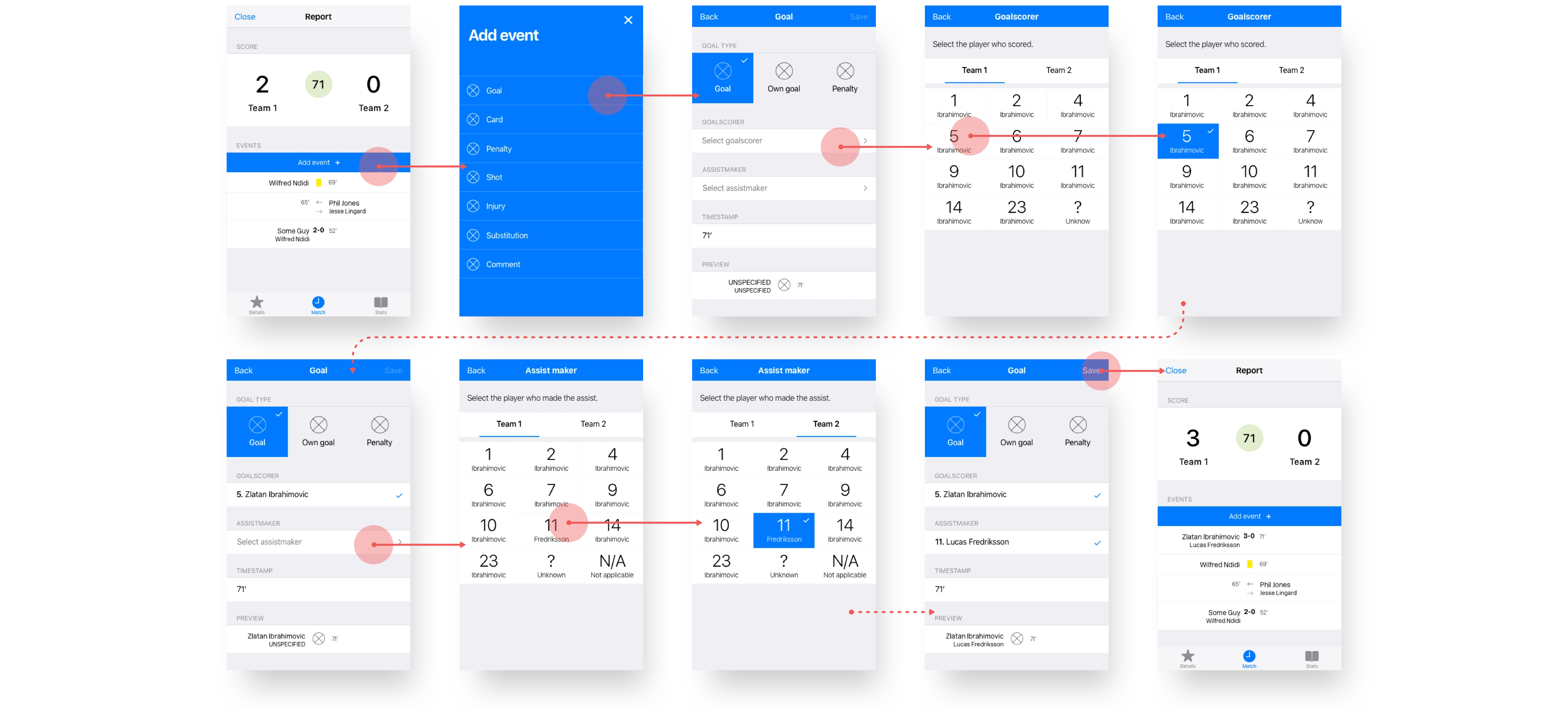
Exploration of journey to report a goal.
MVP Trade-offs & Systems Thinking
To ship a functional proof-of-concept in just a few months, we had to be ruthless with our MVP scope. Rather than attempting to support every possible match event, we intentionally restricted the launch to the absolute essentials: goals, injuries, and substitutions.
Because we were building outside of the main app's legacy codebase, I took the opportunity to establish a new, bottom-up design system optimized entirely for mobile. I created a scalable component library from scratch, including a comprehensive custom iconography set tailored for rapid, on-the-fly sports reporting.
The Final Experience
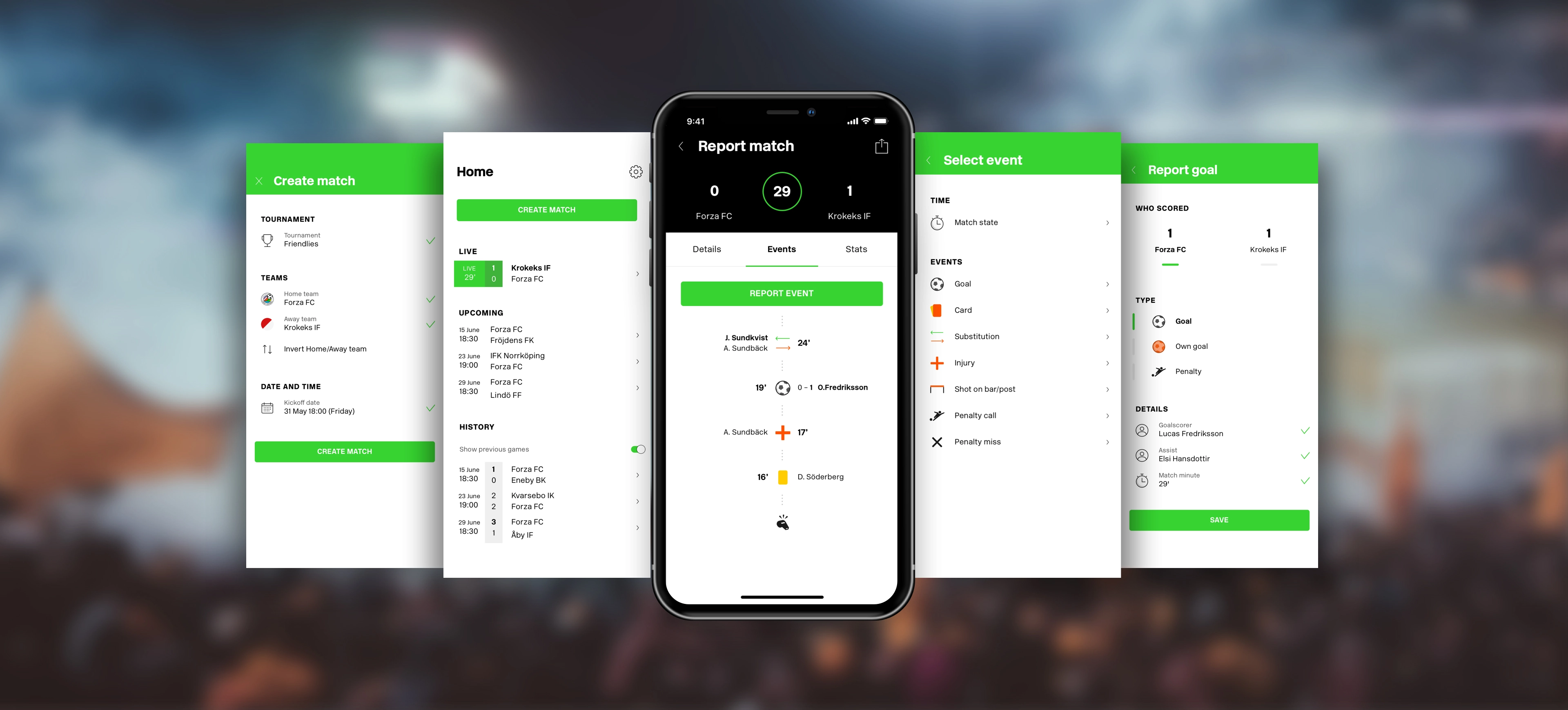
The final product was built for speed, relying on progressive disclosure to separate the user's workflow into three highly focused stages:
Pre-Match Setup: Handles administrative tasks (line-ups, formations) long before kickoff, removing friction from game day.
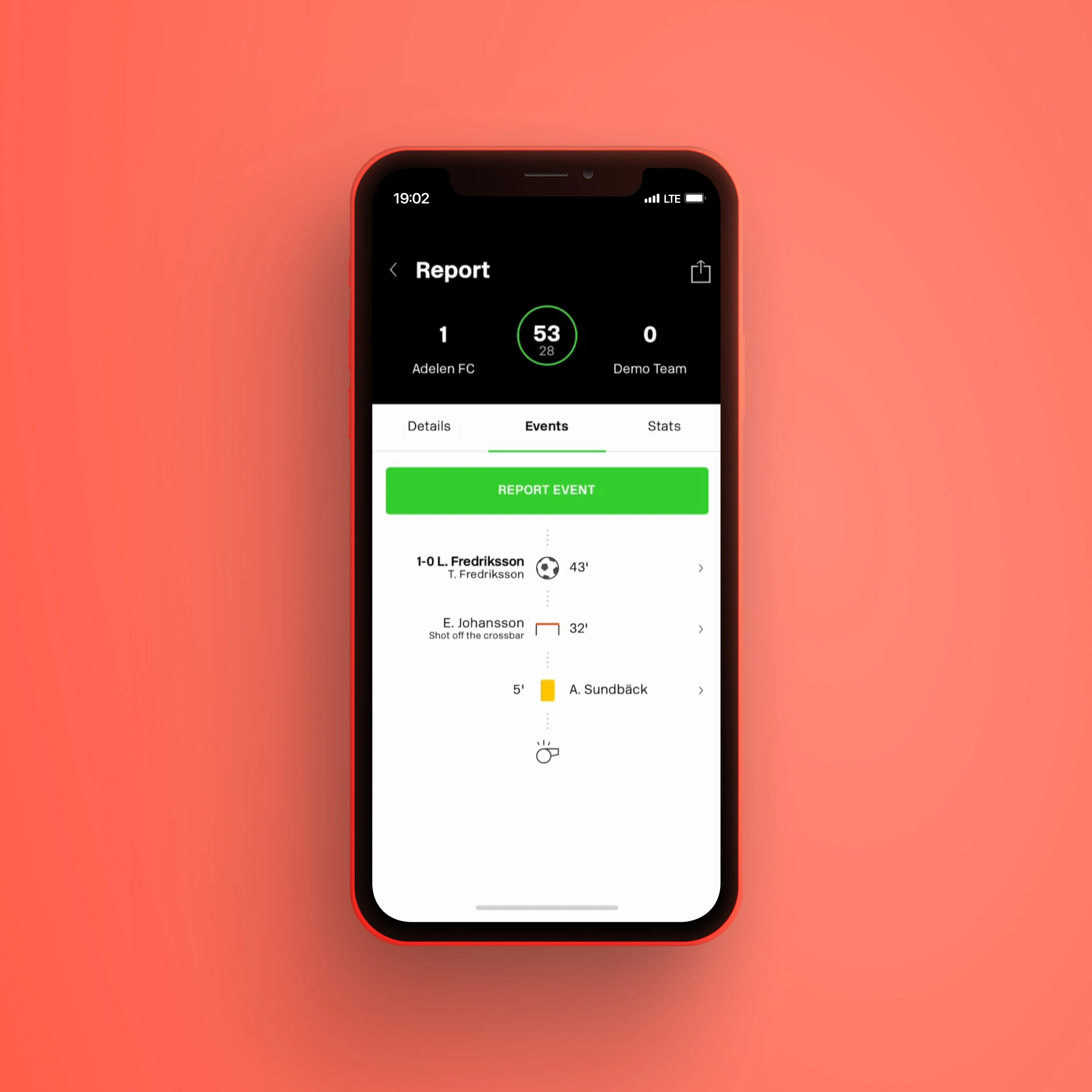
Live Reporting: The core engine. It utilizes a familiar timeline UI and massive, tap-friendly action buttons to capture rapid events with zero hesitation.
Advanced Stats: Designed for power-users. By moving complex data (possession, shots) to a secondary tab, we kept the primary reporting screen clean and unintimidating for the 90% of users who just need the basics.
Business Impact & Scale
Forza Football Reporter was a massive success, directly enabling an official partnership with Gothia Cup (the world's largest youth football tournament) in 2019.
Beyond community hype, it fundamentally shifted the company's trajectory. As user growth in the main livescore app began to plateau, this reporting tool unlocked an entirely new, grassroots acquisition funnel. What started as an agile, 4-person proof-of-concept became the company's biggest strategic bet, scaling into a dedicated 9-person product team by 2020.
Promotional video for Forza Football Reporter.
TL;DR
I led the 0-to-1 design of Forza Football Reporter, a live-reporting mobile app that unlocked a new user acquisition funnel for Forza by democratizing coverage of youth and amateur football.
0-to-1 Product Leadership: Steered the UX from initial field research to a live proof-of-concept, eventually scaling the initiative into a dedicated 9-person product team.
Contextual UX: Designed a highly ergonomic, forgiving mobile interface optimized for extreme sideline conditions (sun glare, high cognitive load, one-handed use).
Design Systems: Established a bottom-up mobile design system from scratch, including a custom sports iconography library.
Business Growth: The product's success directly secured an official partnership with the Gothia Cup, the world's largest youth football tournament.